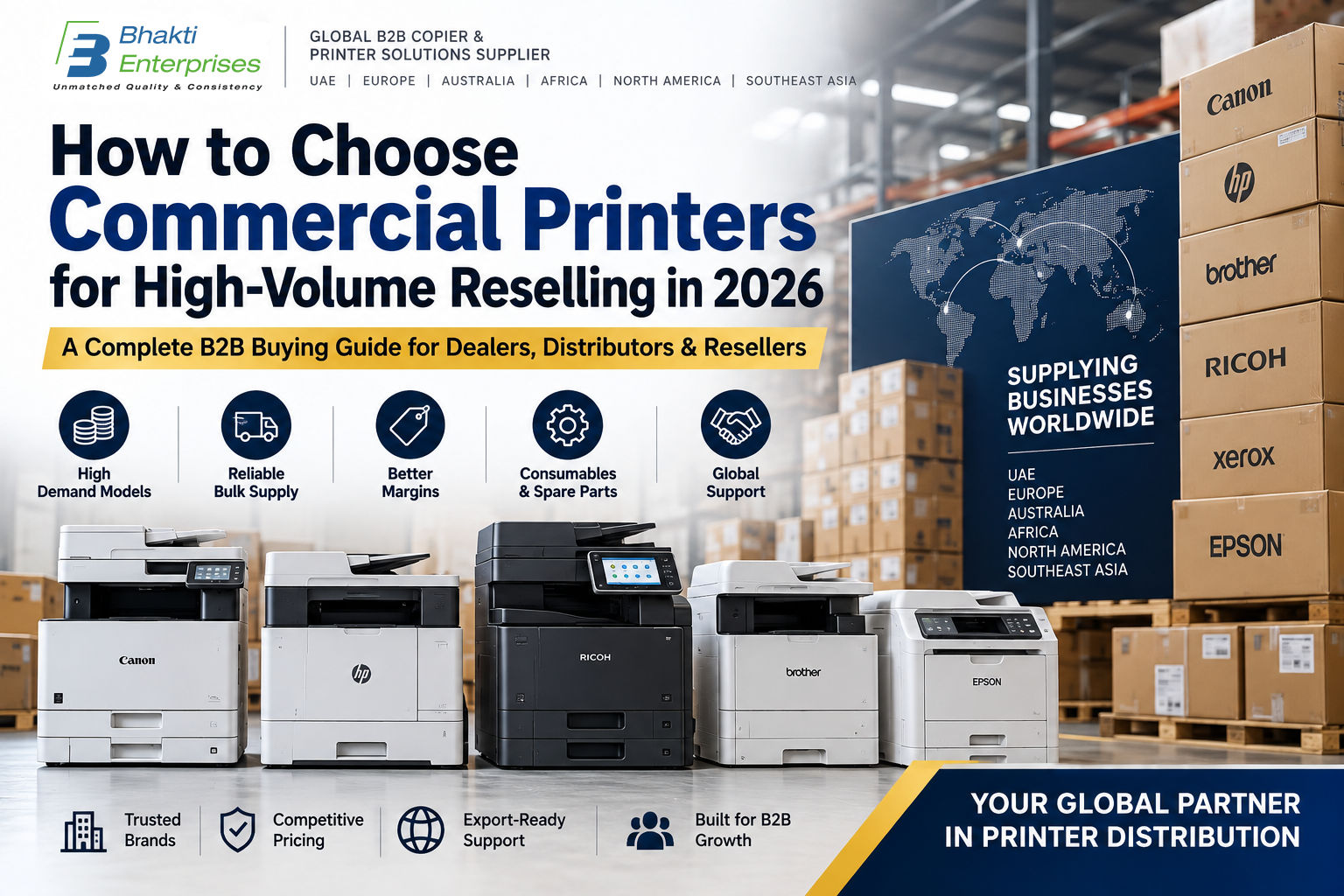
How to Choose Commercial Printers for High-Volume Reselling in 2026
Bhakti Enterprises
Key takeaways
- Demand first: Select printer models with consistent demand among offices, enterprises, institutions and commercial users.
- Volume capability: Confirm that the supplier can consistently fulfil repeat bulk orders, not just one shipment.
- Total resale economics: Calculate purchase price, freight, duties, consumables, warranty exposure and expected reseller margin.
- Consumables matter: Toner cartridges, drums, fuser components and other replacement parts can influence repeat business.
- Regional support: Confirm availability of technical documentation, replacement parts and service arrangements in the target market.
- Before ordering: Request a model-wise quotation showing MOQ, lead time, warranty, packaging and shipping terms.
Table of contents
Choose commercial printers based on volume, margins, supply, consumables and support. Built for serious B2B resellers.
Commercial printer resellers have a different buying problem from end users. You are not simply choosing a machine for your own office - you are selecting products that must sell repeatedly, remain competitively priced and be supported throughout their working life. This guide is designed for dealers, distributors, importers, wholesalers and B2B resellers purchasing printers in volume. By the end, you will know how to assess demand, specifications, supplier reliability, margins, consumables and after-sales requirements before committing to a bulk order.
TIP - Before You Start: 3 Key Questions 1. What is your expected monthly sales volume? Estimate units by model, customer segment and target market rather than ordering only from projected annual demand. 2. What does your customer actually require? Determine print speed, mono/colour output, A4/A3 capability, duplex printing, connectivity, scanning and duty-cycle requirements. 3. What is your real landed and resale cost? Include product price, freight, insurance, customs duties/taxes, warehousing, warranty exposure and financing costs before calculating your margin.
1. Start With Market Demand and Resale Potential
For a high-volume reseller, the first question should not be “Which printer has the most features?” It should be “Which printer can I sell repeatedly in my target market?” A technically impressive model with weak local demand can tie up working capital and increase inventory risk. Segment your demand by customer type. SMEs may prioritize affordable mono laser printers and multifunction devices, while corporate offices may require higher print speeds, duplexing, network management and larger paper capacities. Print shops and production environments have different requirements again. Review your previous sales, enquiry history, distributor requests and customer specifications. If you are entering a new market, compare competing models, cartridge availability and local selling prices before committing to inventory. For bulk purchasing, establish a realistic monthly requirement rather than relying on a single large order. For example, a reseller moving 100 units per month should negotiate supply arrangements around recurring demand instead of treating every shipment as an isolated transaction. The objective is to create a product portfolio with predictable turnover, manageable inventory and sufficient margin.
CHECK
2. Evaluate Supplier Capacity Before Negotiating Price
A low unit price is useful only if the supplier can deliver the required quantity when your customers need it. High-volume resellers should therefore assess supplier capacity, stock consistency and lead times before focusing exclusively on price. Ask suppliers whether the quoted quantity is available from current stock or depends on future procurement. A supplier able to provide 20 units immediately may not be capable of supporting 200 or 500 units on a recurring basis. For international B2B orders, confirm production or sourcing lead time, export packing, shipment readiness, documentation and preferred Incoterms. Also establish whether repeat orders receive the same commercial terms. Supply continuity becomes particularly important when you advertise specific models to dealers or corporate customers. A stock-out can result in delayed customer deliveries, lost tenders and substitution with competing brands. Request a written supply commitment wherever practical. Your purchasing team should know the expected MOQ, available quantity, replenishment cycle and standard lead time before accepting customer orders.
CHECK
3. Compare Total Resale Economics, Not Just Purchase Price
The purchase price is only one part of a reseller's economics. A printer purchased cheaply can become less attractive if freight, import costs, warranty claims, slow-moving inventory or expensive consumables reduce the final margin. Calculate the landed cost per unit before approving a purchase order. Include product cost, international freight, insurance, customs duties where applicable, local transportation, warehousing and payment-related costs. Then calculate your expected resale price using actual competitor pricing rather than an assumed markup. For example, if a printer costs $180 and additional landed expenses are $30, your effective cost is $210—not $180. A 15% markup on the purchase price would also not represent a 15% margin on your final selling price. For large-volume procurement, even a small difference in landed cost can become significant. A $5 saving across 1,000 units represents $5,000 before considering any additional financing or logistics effects. Also assess inventory turnover. A lower-margin product that sells consistently may produce a different commercial result from a high-margin model that remains in stock for months.
CHECK
4. Check Consumables, Spare Parts and Product Lifecycle
For printer resellers, the machine sale can be only the beginning of the customer relationship. Consumables and replacement components can influence customer satisfaction, repeat purchases and long-term product viability. Before importing or distributing a model, identify its compatible toner or ink cartridge references and determine whether those supplies are readily available in the destination market. For laser printers and multifunction devices, also investigate components such as drums, drum cleaning blades, fuser films or sleeves, transfer components and other commonly replaced parts where applicable. This is particularly important when selling to dealers who expect continued supply after the initial equipment purchase. A model with strong printer demand but limited access to consumables can create service problems later. Conversely, a widely supported model can create opportunities for repeat consumables and spare-parts business. Ask your supplier for a current compatibility list and verify that the exact cartridge and component references correspond to the specific printer model and regional variant.
CHECK
5. Assess Brand, Technical Support and Regional Requirements
Brand recognition can influence reseller demand, but brand selection should also be evaluated against your target market and supplier network. Brands such as Canon, HP, Brother, Epson, Xerox and Ricoh have different product ranges, market positioning and distribution structures. For export markets, verify the exact model variant being supplied. Product specifications, electrical requirements, wireless features, language options, warranty coverage and consumable references can vary between regions. Technical support is another important consideration. Your reseller network may require manuals, firmware information, troubleshooting documentation and access to replacement parts. Establish in advance how warranty claims and defective units will be handled. Do not assume that an international manufacturer's brand presence automatically means that every distributor or reseller has identical warranty or service rights. Confirm the commercial terms applying to your specific purchase. For markets such as the UAE, Europe, Africa, Southeast Asia, Australia and North America, evaluate logistics, documentation, regulatory requirements and local service arrangements alongside the printer itself.
CHECK
Commercial Printer Buyer Profile Guide 2026
| Office / Reseller Segment | Monthly Volume | Recommended Type | Brands to Consider |
|---|---|---|---|
| Small reseller / SME-focused dealer | Under 5,000 pages | Compact mono/colour laser or MFP | HP, Brother, Canon, Epson |
| Medium B2B reseller | 5,000–30,000 pages | Business laser MFP / A3 MFP | Canon, Brother, HP, Ricoh, Xerox |
| Large-volume commercial reseller | Over 30,000 pages | High-speed business MFP / production-oriented equipment | Canon, Ricoh, Xerox, Konica Minolta |
Actual model selection should be based on customer requirements, duty cycle, recommended monthly volume, regional availability and supplier support.