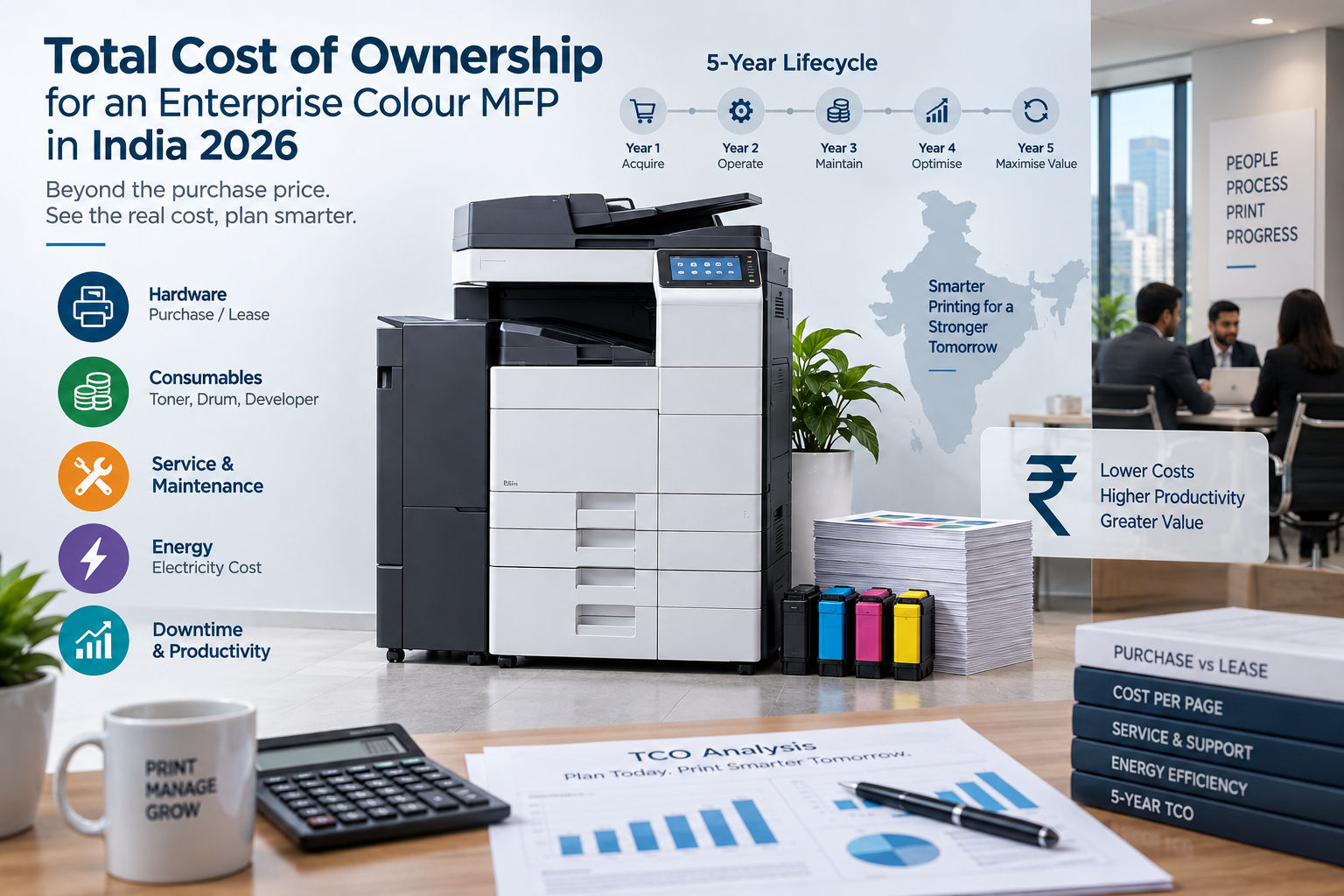
Total Cost of Ownership for an Enterprise Colour MFP in India 2026
Bhakti Enterprises
Key takeaways
- A representative new A3 colour MFP is budgeted at approximately ₹3,00,000 for this analysis.
- At 10,000 pages/month with a 70:30 mono-to-colour mix, consumables are estimated at approximately ₹52,000/year.
- A comprehensive service allowance of ₹45,000/year represents a significant part of lifecycle cost.
- Estimated 5-year ownership TCO is approximately ₹9.22 lakh, excluding paper and GST.
- Consumables and service provide a much larger saving opportunity than electricity, which is estimated at only about ₹1,400/year in this scenario.
- Buying has the lower nominal five-year cost in this model; leasing can still make sense where cash-flow preservation, bundled service or technology refresh is more important than minimum total cost.
Table of contents
This analysis calculates the 5-year Total Cost of Ownership of an enterprise A3 colour MFP in India at 10,000 pages per month. It covers acquisition, toner, imaging components, service, electricity and downtime to determine the real cost of buying versus leasing a business copier.
An enterprise colour MFP should not be evaluated only by its purchase price. This analysis models a representative 36-ppm A3 colour MFP in India at 10,000 pages per month, or 120,000 pages annually, using a 70% monochrome and 30% colour workload. The calculation covers hardware, toner, imaging components, service, electricity and downtime. The objective is to determine what the machine actually costs over five years and whether buying or leasing produces better financial value.
Key Financial Finding
Under the stated assumptions, the estimated ownership cost is approximately ₹1.84 lakh per year and ₹9.22 lakh over five years, excluding paper and GST. Consumables and service account for roughly ₹97,000 annually, making them far more important to TCO than electricity.
What Belongs in a True TCO Calculation
Purchase price is only the starting point of a copier investment. An enterprise MFP can remain in service for five years, so relatively small recurring expenses can become larger than the original hardware investment. Toner yield, print coverage, imaging-unit replacement, service visits, parts, energy use and employee downtime all influence the actual cost of producing documents. For a 10,000-page monthly workload, this distinction becomes particularly important. A machine with a lower acquisition price can become more expensive if its toner costs more or its service plan is restrictive. Conversely, a higher-priced machine may produce a lower TCO if its consumables last longer and its service requirements are lower. A proper five-year calculation therefore evaluates the complete lifecycle rather than simply comparing MRP or purchase quotations.
CHECKLIST - 8 TCO COST CATEGORIES:
Hardware Acquisition - Purchase vs Lease vs Rental
For this analysis, a planning purchase price of ₹3,00,000 is used for a new enterprise-class A3 colour MFP, including a representative configuration but excluding GST. Actual Indian pricing varies substantially by speed, finishing options, document feeder, storage, connectivity and service package. Current market listings show that A3 colour MFP pricing can vary widely, so the ₹3,00,000 figure should be treated as a budgeting assumption rather than a supplier quotation. Amortising ₹3,00,000 over five years gives ₹60,000 per year, or ₹5,000 per month. For comparison, a hypothetical 60-month finance lease at ₹8,500 per month would produce ₹5,10,000 in scheduled payments before considering taxes, finance charges, deposits or end-of-term conditions. A lease may therefore cost more in nominal rupees while offering predictable monthly expenditure and preserving upfront working capital. Buyers should check whether the lease includes maintenance, toner, installation, insurance, early termination charges and ownership transfer. A low monthly lease payment is not automatically a low-TCO option.
Consumables - Toner, Drum and Developer
Consumables are normally the most important variable cost in a colour MFP. As a concrete reference, the Konica Minolta bizhub C360i class uses TN328 toner with published yields of approximately 28,000 pages at 5% coverage for black and the CMY colours. Its imaging components have substantially longer but different rated lives; the black imaging unit is listed at up to 225,000 pages and the colour imaging unit at up to 105,000 pages. For this model, assume 120,000 pages/year, consisting of 84,000 mono pages and 36,000 colour pages. Black toner: ₹4,578 ÷ 28,000 pages = ₹0.164/page based on a current Indian listing. Annual black-toner allowance: 84,000 × ₹0.164 = ₹13,776 For colour printing, this model uses four toner channels. We use a planning allowance of ₹27,500 for a complete CMYK set, giving: ₹27,500 ÷ 28,000 = ₹0.982/page Annual colour-toner allowance: 36,000 × ₹0.982 = ₹35,352 Estimated annual toner cost: ₹13,776 + ₹35,352 = ₹49,128 Adding approximately ₹3,300 annually for imaging-unit consumption produces a total consumables allowance of approximately ₹52,400/year. Actual cost will change with coverage, document type and the negotiated toner/service arrangement. The manufacturer’s 5% yield specification is therefore a benchmark, not a guarantee of real-world page count.
Service, Maintenance and Support
A business copier should be evaluated together with its service arrangement. For a 10,000-page/month workload, this analysis uses a ₹45,000 annual comprehensive-service allowance, or ₹3,750 per month. A comprehensive agreement should clearly state whether labour, preventive maintenance, service calls, standard replacement parts and consumables are included. Some contracts exclude toner, drums, developer, fuser assemblies or damage caused by unsuitable media. Those exclusions can materially change the effective cost per page. For enterprise use, the SLA should specify response time, target resolution time, escalation procedures and availability of replacement equipment when a prolonged failure occurs. A useful benchmark is next-business-day response for standard incidents, with faster escalation for critical production environments. The right comparison is therefore not simply "₹45,000 AMC versus ₹30,000 AMC." Buyers should compare exactly what each contract covers and what expenses remain outside the contract.
Energy Consumption
Electricity is important from an environmental and operational perspective, but it is usually a relatively small part of copier TCO at this workload. A representative C360i-class machine is specified at around 560 W while printing in colour and approximately 48 W in ready mode; its maximum rated consumption is around 1.5–1.58 kW. Assuming 120,000 pages annually, 36 pages per minute and a 250-day office year, active printing represents roughly 55.6 hours. Adding approximately 2,194 ready hours gives an estimated annual electricity use of about 140 kWh. At a planning commercial electricity rate of ₹10/kWh, annual energy cost is approximately: 140 kWh × ₹10 = ₹1,400/year Actual electricity billing depends on state, tariff category, demand charges and office operating patterns. Maharashtra, for example, publishes tariff orders through MSEDCL, so commercial buyers should use their actual electricity tariff when preparing a site-specific TCO model.
TABLE - A3 Colour MFP estimated annual TCO breakdown - India 2026
A3 Colour MFP estimated annual TCO breakdown - India 2026
| Cost Category | Annual Estimate (INR) | Assumptions |
|---|---|---|
| Hardware (amortised over 5 years) | ₹60,000 | ₹3,00,000 purchase price ÷ 5 years |
| Consumables (toner + imaging) | ₹52,400 | 10,000 pages/month; 70% mono / 30% colour |
| Service contract | ₹45,000 | Comprehensive service allowance |
| Energy | ₹1,400 | Approx. 140 kWh × ₹10/kWh |
| Downtime / admin | ₹25,000 | Planning allowance for admin time and minor productivity loss |
| TOTAL ANNUAL | ₹1,83,800 | |
| 5-YEAR TCO | ₹9,19,000 |
Note: Rounded component assumptions produce approximately ₹9.19 lakh. A conservative contingency allowance can take the planning figure to approximately ₹9.22 lakh over five years. Paper, GST, financing charges and major exceptional repairs outside the service agreement are excluded.
How to Reduce Your Copier TCO: 5 Practical Steps
1) Control colour printing If 10,000 monthly pages move from a 70:30 mono/colour mix toward 80:20, annual colour volume falls by 12,000 pages. At the planning colour-toner allowance of ₹0.982/page, that represents approximately ₹11,800/year in toner-related savings before other effects. 2) Negotiate a bundled service structure A well-negotiated comprehensive contract can reduce unpredictable repair and consumable expenditure. Reducing the assumed annual service cost from ₹45,000 to ₹40,000 would save ₹25,000 over five years. 3) Compare cost per page, not toner price A cheaper cartridge is not necessarily cheaper printing. Compare cartridge price ÷ tested yield, then account for actual coverage. At ₹4,578 for 28,000 black pages, the benchmark black toner cost is approximately 16 paise/page. 4) Use duplex printing by default If duplex printing reduces physical sheets by 25% for a 120,000-page workload, the business could avoid approximately 30,000 sheets/year. The financial saving depends on paper price and whether the workload is currently simplex. 5) Match machine capacity to actual volume Avoid buying a high-end production-class machine for a moderate 10,000-page monthly workload. Selecting a machine designed for the actual duty cycle can reduce the initial investment while maintaining adequate reliability and service capacity.
SUCCESS - The Bottom Line
At 10,000 pages per month, a representative enterprise A3 colour MFP should be evaluated as a ₹9 lakh-plus five-year investment, not simply as a ₹3 lakh hardware purchase. In this scenario, toner and service dominate the recurring cost, while electricity contributes comparatively little. For a machine-specific TCO calculation and commercial quotation, request a detailed proposal from Bhakti Enterprises.