Canon vs Ricoh vs Kyocera vs Konica Minolta: 2026 Copier Comparison
Bhakti Enterprises
Key takeaways
- Canon is strong for enterprise document workflows and security integration.
- Ricoh excels across scalable A3 colour MFP and workflow environments.
- Kyocera offers broad TASKalfa options for efficiency-focused print fleets.
- Konica Minolta delivers intuitive bizhub workflows and finishing options.
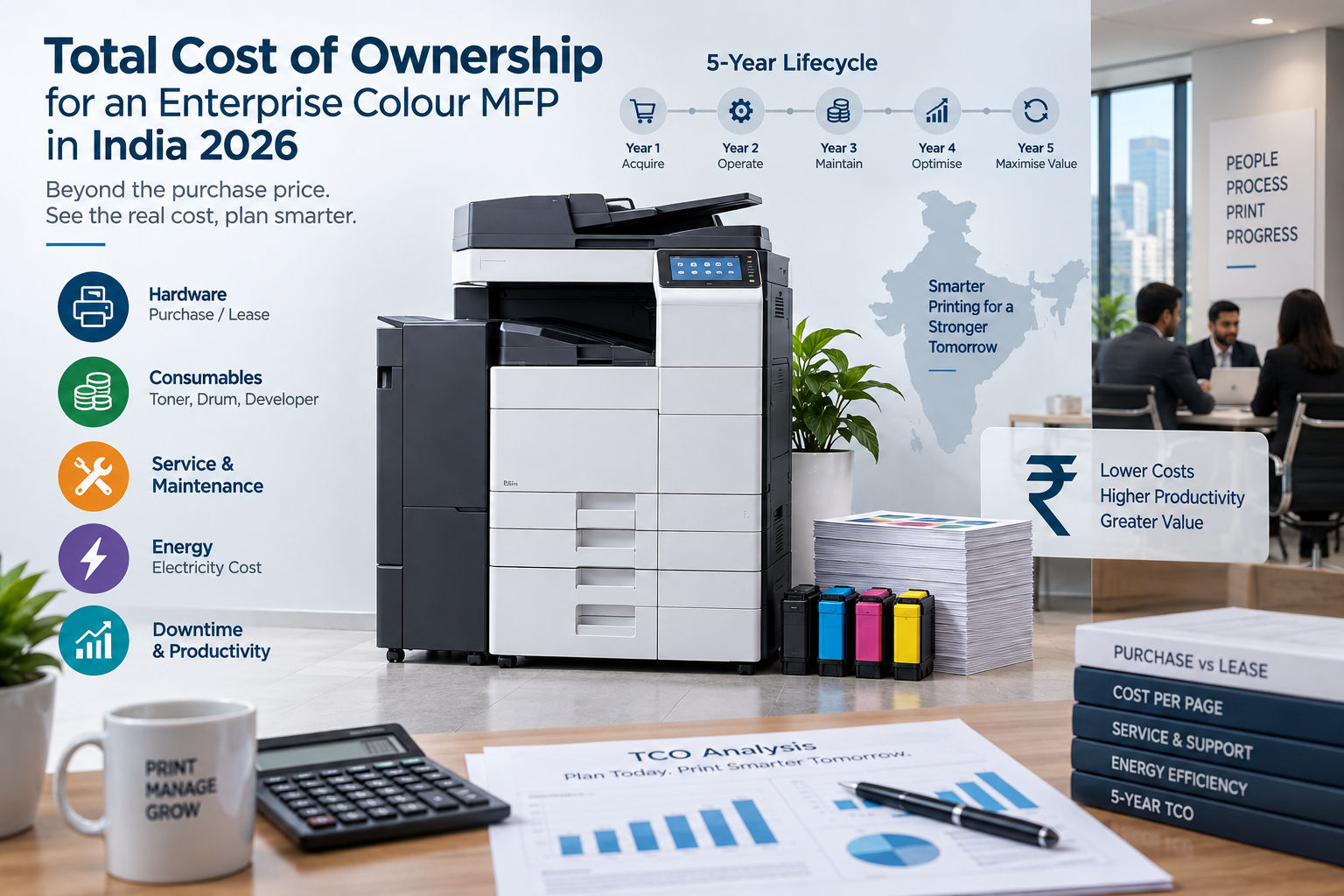
- Compare consumables, service contracts and downtime—not only acquisition price.
- Regional service coverage and parts availability can materially change TCO.
Table of contents
Compare Canon, Ricoh, Kyocera and Konica Minolta for international B2B buyers and identify the right copier for your business.
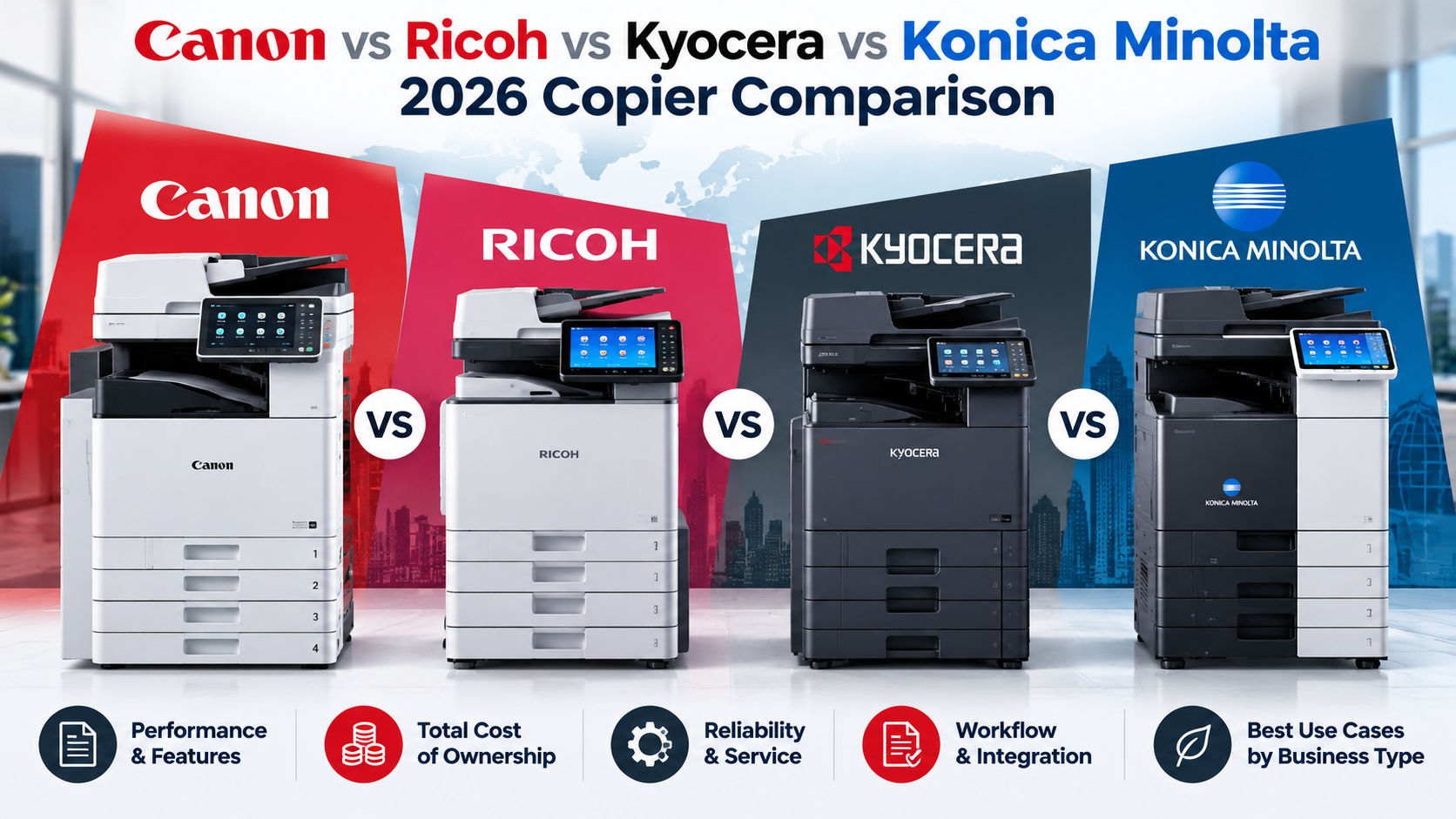
Canon, Ricoh, Kyocera and Konica Minolta remain important brands for international B2B copier and multifunction-printer procurement. This comparison is designed for procurement managers, IT buyers, office managers and distributors evaluating A3/A4 MFP fleets across markets such as the UAE, Europe, Australia, Africa, North America and Southeast Asia. The practical comparison focuses on product families, workflow capabilities, scalability, consumables, service considerations and total cost of ownership rather than headline hardware price alone.
Canon is particularly well suited to enterprise document workflows, security and integrated office environments. Ricoh is a strong choice for broad MFP fleets, workflow automation and scalable office printing. Kyocera is well suited to efficiency-focused businesses requiring scalable TASKalfa mono and colour MFPs. Konica Minolta combines intuitive bizhub operation, workflow functionality and a broad office-device portfolio.
| Brand | Best For | Key Strength | Recommended Business Type |
|---|---|---|---|
| Canon | Enterprise document environments | imageRUNNER ADVANCE DX workflow and security capabilities | Corporates, legal, finance, professional services |
| Ricoh | Scalable office MFP fleets | Broad IM-series portfolio and workflow ecosystem | Enterprises, distributed offices, service providers |
| Kyocera | Efficiency-focused printing | TASKalfa portfolio spanning office to high-volume production | Cost-conscious businesses, institutions, high-volume offices |
| Konica Minolta | Digital workplace workflows | bizhub interface, workflow and finishing capabilities | Corporate offices, education, professional services |
Canon (imageRUNNER ADVANCE DX): Enterprise document workflow specialist
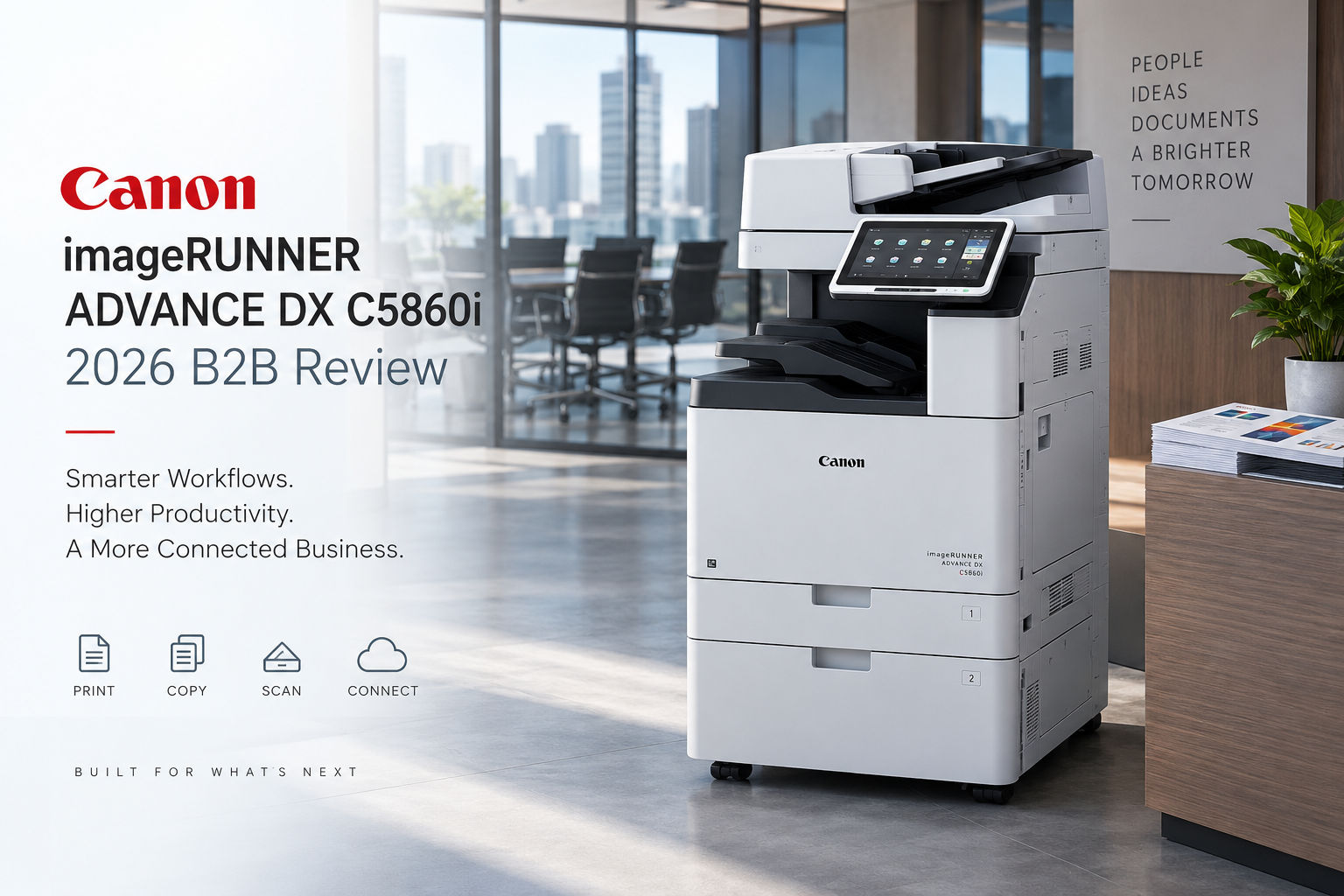
Canon's imageRUNNER ADVANCE DX family is positioned around multifunction document environments combining print, copy, scan, send and storage. The C5800 series, for example, uses a 10.1-inch colour touchscreen, 256GB standard SSD and single-pass duplex document feeding, with configurations supporting substantial paper and finishing capacity. Canon also provides authentication and access-control functions within the enterprise range. For international B2B buyers, Canon becomes particularly relevant when the copier is part of a larger document-management environment rather than simply a standalone printer. Businesses handling contracts, invoices, customer records and regulated documents can evaluate Canon around workflow integration, user authentication, scanning and secure document handling. The imageRUNNER ADVANCE DX family also spans different speeds and configurations, allowing procurement teams to match equipment to departmental workloads instead of buying the same specification for every location. The important procurement issue is configuration. A base machine and a fully configured MFP with finishing, additional paper capacity, storage and workflow software can represent very different investments. Buyers should therefore compare the complete deployment rather than comparing catalogue prices between brands.
Ricoh (IM C Series): Scalable MFP and workflow platform
Ricoh's IM portfolio covers a wide range of A3 colour MFP configurations. Its documented IM C family includes models from the IM C2000 through the IM C6000, with output speeds from 20 to 60 pages per minute in that series; Ricoh also lists newer IM C-series models in its global product-support portfolio. The main attraction for international B2B procurement is portfolio breadth. A company operating several offices can standardise around a vendor while selecting different device classes for headquarters, branches, finance departments, customer-facing teams and high-volume departments. Ricoh's MFP platforms also support scanning, network connectivity and mobile-printing workflows, making them suitable for offices moving beyond traditional copy-and-print requirements. Ricoh is especially relevant where the MFP is expected to become part of a wider workflow environment. Procurement teams should evaluate document capture, scan destinations, authentication, fleet management, finishing and service support alongside raw print speed. The exact model matters considerably because specifications differ throughout the IM portfolio.
Kyocera (TASKalfa): Efficiency-focused high-volume MFP platform
Kyocera's TASKalfa range covers mono and colour multifunction devices from departmental systems to high-volume environments. Current documented TASKalfa models include the TASKalfa 2553ci through 6053ci colour range, while higher-speed TASKalfa systems reach 50, 60 and 70 ppm classes. Kyocera's specifications also show high paper capacity, dual-scan options and support for A3/SRA3 media on relevant models. This breadth makes Kyocera particularly relevant for organisations where predictable document production and fleet efficiency are major procurement considerations. The TASKalfa range supports printing, copying, scanning and optional fax, with different configurations supporting substantial paper capacity and high-speed scanning. Some current models provide dual-scan speeds reaching 274 images per minute under specified configurations. For procurement managers, Kyocera should be evaluated using actual monthly page volumes, colour-to-mono ratios, consumables requirements and service coverage. The same brand can serve a small departmental environment and a much larger production-oriented workload, so the model and configuration determine the commercial outcome.
Konica Minolta (bizhub i-Series): Intuitive office workflow and finishing
Konica Minolta's bizhub portfolio combines multifunction printing with document workflow capabilities and an emphasis on user interaction. Current European models include the bizhub 4701i at up to 47 ppm and bizhub 4051i at up to 40 ppm, with features including touchscreen interfaces, network connectivity and optional wireless functionality. The broader bizhub portfolio also includes A3-capable colour MFPs. For example, the bizhub C301i provides up to 30 ppm A4 mono/colour output, a 10.1-inch panel, 8GB memory and standard 256GB SSD storage. For B2B buyers, Konica Minolta is particularly relevant when usability, workflow and finishing need to work together. Businesses should evaluate how employees actually interact with the MFP, how documents are scanned and routed, and what finishing options are required. As with the other three brands, procurement should be based on a complete configuration and local service model rather than brand reputation alone.
"Important Buying Advice"
Do not select a copier based only on purchase price or advertised pages-per-minute. Compare the complete 3–5-year cost including toner, drums or imaging components, maintenance contracts, spare parts, installation, software, finishing accessories, energy consumption and expected downtime. International buyers should also verify local technical support and parts availability before signing a fleet contract.
Verdict: Which Brand Is Right for Your Business?
Canon, Ricoh, Kyocera and Konica Minolta can all support serious B2B document environments, but their strongest practical use cases differ. Choose Canon when enterprise document workflows, authentication, security and integration with broader document processes are central to procurement. The imageRUNNER ADVANCE DX family provides a strong platform for organisations managing sensitive or structured documents. Choose Ricoh when you need a broad, scalable MFP fleet across departments or multiple locations. Its IM portfolio provides multiple speed and configuration classes, allowing organisations to standardise while matching equipment to different workloads. Ricoh Choose Kyocera when high-volume document production, fleet efficiency and scalable TASKalfa configurations are important. Its current portfolio extends from departmental systems through high-speed mono and colour MFPs. Choose Konica Minolta when intuitive operation, workflow functionality and finishing are important components of the office environment. Its bizhub portfolio spans compact A4 systems through larger A3-capable MFPs. For UAE, Europe, Australia, Africa, North America and Southeast Asia, one additional variable can change the economics substantially: local service and parts coverage. A theoretically inexpensive device can become expensive if critical consumables or spare parts have long lead times. For an accurate procurement decision, compare the exact models, expected monthly volume, consumables pricing, service contract, spare-parts availability and 3–5-year TCO. Bhakti Enterprises can help international B2B buyers evaluate copier, printer, spare-part and consumables requirements across markets.
Sources & references
- [1]
- [2]
- [3]
- [4]
- [5]
- [6]